Package
discord-component-embed v1.0.0
discord-component-embed
Show your own card when someone shares your link on Discord.
Changelog · Reference · Discord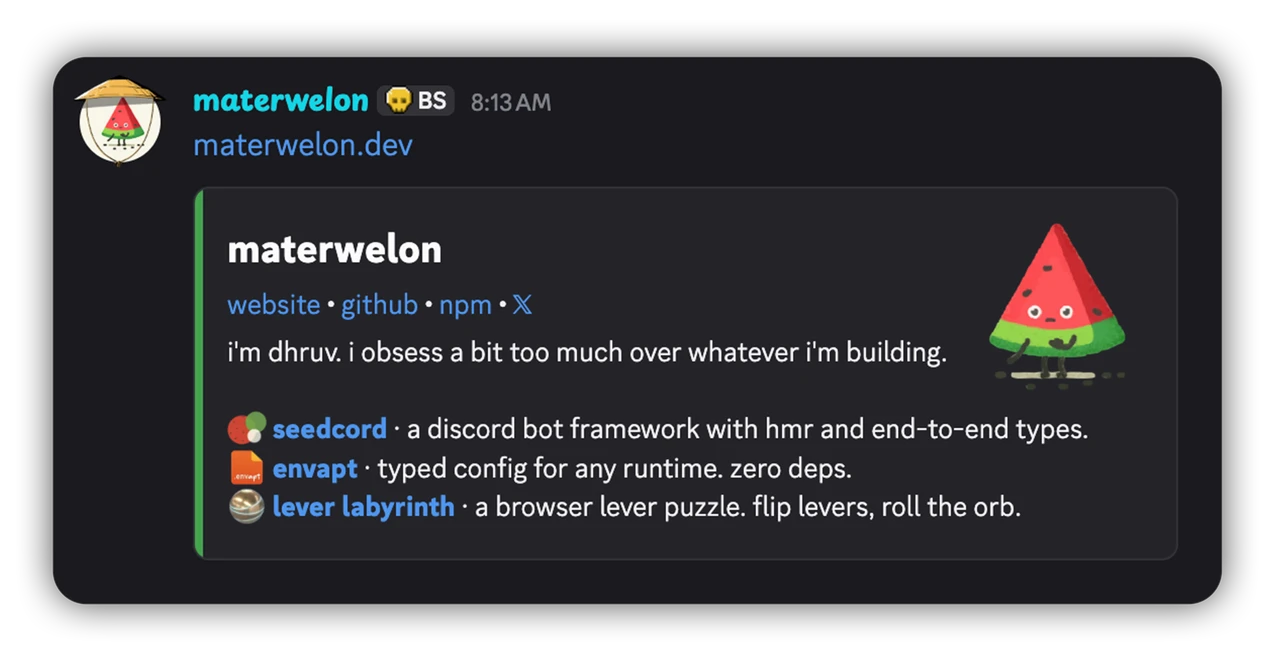


Contents
- About
- Installation
- Build a card
- Put it in your page
- JSX setup
- Linked JSON
- JSON you already have
- Check from the command line
- Your own components
- Custom emoji
- Testing your card
- Components
- Errors
About
When someone pastes a link to your site into Discord, Discord fetches the page and builds a preview card from its Open Graph tags. A component embed replaces that card with a layout made of Discord's message components: markdown, images, a gallery, an accent color, and link buttons. The card above is one.
You describe the card with JSX or with h(), in any framework or none. The package checks it against Discord's rules for the format, then writes the JSON Discord reads from your page.
Discord marks link previews as subject to change. This library keeps up with those changes as they happen. Any breaking change will ship in a major version.
Installation
pnpm add discord-component-embedYou don't need React. Only discord-component-embed/react uses it, and it works with React 17, 18, and 19. The library doesn't import anything from Node, so it runs on Node, Bun, Deno, and edge runtimes. Only the check command uses Node's APIs, which Bun and Deno also provide.
Build a card
A card is a tree of components with one <Container> at the root.
// src/cards/PostCard.tsx
import { ActionRow, Container, LinkButton, Section, TextDisplay, Thumbnail } from 'discord-component-embed';
import type { Post } from '../lib/posts';

export function PostCard({ post }: { post: Post }) {
    return (
        <Container accentColor={0x45a44f}>
            <Section accessory={<Thumbnail url={post.cover} description={post.coverAlt} />}>
                <TextDisplay>
                    # [{post.title}]({post.url}){'\n'}
                    {post.summary}
                </TextDisplay>
                <TextDisplay>-# {post.readingTime} min read</TextDisplay>
            </Section>
            <ActionRow>
                <LinkButton url={post.url} label="Read" />
                <LinkButton url="https://example.com/rss.xml" label="RSS" />
            </ActionRow>
        </Container>
    );
}
0x45a44f colors the bar down the card's left edge. Discord shows the <Thumbnail> to the right of the two blocks of text. JSX turns a line break in your source into a space. The {'\n'} after the title puts post.summary on its own line.
This file compiles with React's JSX, Preact's, or the package's own. If your project has no JSX yet, JSX setup shows the two lines to add.
Without JSX, build the same card with h(). It takes a component, its props, then its children.
// src/cards/buildPostCard.ts
import { ActionRow, Container, LinkButton, Section, TextDisplay, Thumbnail, h } from 'discord-component-embed';
import type { Post } from '../lib/posts';

export function buildPostCard(post: Post) {
    return h(
        Container,
        { accentColor: 0x45a44f },
        h(
            Section,
            { accessory: h(Thumbnail, { url: post.cover, description: post.coverAlt }) },
            h(TextDisplay, null, `# [${post.title}](${post.url})\n${post.summary}`),
            h(TextDisplay, null, `-# ${post.readingTime} min read`)
        ),
        h(
            ActionRow,
            null,
            h(LinkButton, { url: post.url, label: 'Read' }),
            h(LinkButton, { url: 'https://example.com/rss.xml', label: 'RSS' })
        )
    );
}
TypeScript checks each h() call against the component's props. A Section without an accessory fails to compile, and so does a TextDisplay without text.
Put it in your page
Discord doesn't run JavaScript when it fetches your page. The card has to be in the HTML your site serves, as a <script> tag with the card's JSON inside. It works in the <head> or the <body>.
| your site | works | how |
|---|---|---|
| server rendering (Next, Nuxt, SvelteKit, Astro) | yes | the server writes the tag into each page |
static build (Astro, Next output: 'export', SvelteKit prerender, Eleventy) |
yes | the build writes the tag into each HTML file |
| plain HTML | yes | generate the tag once and paste it in |
client-only app, where index.html starts empty |
one card for the whole site | a tag added in the browser never reaches Discord, so put one tag in index.html |
Keep your Open Graph tags. Other sites and apps build their previews from them, and Discord falls back to them for most component embeds it can't use.
Discord reads the tag from each page separately. If you add it to a layout that every page shares, every page shows the card, so add it only to the pages that should show one.
React and Next.js
<ComponentEmbed> renders the tag.
// app/blog/[slug]/page.tsx
import { ComponentEmbed } from 'discord-component-embed/react';
import { PostCard } from '@/cards/PostCard';
import { getPost } from '@/lib/posts';

export default async function BlogPost({ params }: PageProps<'/blog/[slug]'>) {
    const post = await getPost((await params).slug);

    return (
        <>
            <ComponentEmbed>
                <PostCard post={post} />
            </ComponentEmbed>
            <article>{post.body}</article>
        </>
    );
}
Render it on the server or at build time. In a client component, the tag only exists in the browser.
Preact
Preact's JSX builds elements the package reads, so PostCard works as written. toComponentEmbedScript returns the tag as a string, ready for the <head> of the HTML your server sends.
import { toComponentEmbedScript } from 'discord-component-embed';
import { PostCard } from './cards/PostCard';
import { getPost } from './lib/posts';

const post = await getPost(slug);
const tag = toComponentEmbedScript(<PostCard post={post} />);
Vue and Nuxt
Build the card with h(), since Vue's JSX makes Vue elements. Pass its JSON to useHead.
<!-- pages/blog/[slug].vue -->
<script setup lang="ts">
import { toComponentEmbedJson } from 'discord-component-embed';
import { buildPostCard } from '~/cards/buildPostCard';
import { getPost } from '~/lib/posts';

const post = await getPost(useRoute().params.slug);

useHead({
    script: [
        {
            id: 'discord:component-embed',
            type: 'application/vnd.discord.component-embed+json',
            innerHTML: toComponentEmbedJson(buildPostCard(post))
        }
    ]
});
</script>
Discord reads only a script with the id discord:component-embed. Text in the card can't close the tag early, because toComponentEmbedJson escapes any </ and <!-- in the JSON.
Svelte and SvelteKit
Build the card with h() in a server load function, and return the finished tag.
// src/routes/blog/[slug]/+page.server.ts
import { toComponentEmbedScript } from 'discord-component-embed';
import { buildPostCard } from '$lib/cards/buildPostCard';
import { getPost } from '$lib/posts';

export const load = async ({ params }) => {
    const post = await getPost(params.slug);
    return { post, card: toComponentEmbedScript(buildPostCard(post)) };
};
<!-- src/routes/blog/[slug]/+page.svelte -->
<script>
let { data } = $props();
</script>
<svelte:head>
{@html data.card}
</svelte:head>
{@html} can write the tag as it is, because toComponentEmbedScript escapes any </ and <!-- in the JSON.
Astro
JSX inside an .astro file compiles to Astro elements, so build the card in its own file. buildPostCard from Build a card works as it is. For JSX, follow the JSX setup and export a function from a .tsx file that returns <PostCard post={post} />.
---
// src/layouts/Post.astro
import { toComponentEmbedScript } from 'discord-component-embed';
import { buildPostCard } from '../cards/buildPostCard';

const { post } = Astro.props;
---

<html>
    <head>
        <Fragment set:html={toComponentEmbedScript(buildPostCard(post))} />
    </head>
    <body><slot /></body>
</html>
Solid
Build the card with h(), since Solid's Vite plugin compiles every .tsx file with Solid's JSX. Then render the script in a server-rendered route, with the JSON from toComponentEmbedJson.
import { toComponentEmbedJson } from 'discord-component-embed';
import { buildPostCard } from '~/cards/buildPostCard';

<script
    id="discord:component-embed"
    type="application/vnd.discord.component-embed+json"
    innerHTML={toComponentEmbedJson(buildPostCard(post))}
/>;
Solid writes innerHTML into the page as it is. That's safe here, because toComponentEmbedJson escapes any </ and <!-- in the JSON.
Plain HTML
Generate the tag with a short Node script, then paste what it prints into your page's <head>.
// card.mjs, run with: node card.mjs
import { Container, TextDisplay, h, toComponentEmbedScript } from 'discord-component-embed';

const card = h(Container, { accentColor: 0x45a44f }, h(TextDisplay, null, '# My site\nWhat it is about.'));

console.log(toComponentEmbedScript(card));JSX setup
If your project already uses React or Preact, you're set. Their JSX builds elements this package reads.
In a project without a JSX framework, like Astro, Svelte, or a Node script, point TypeScript at the package's JSX:
{
    "compilerOptions": {
        "jsx": "react-jsx",
        "jsxImportSource": "discord-component-embed"
    }
}
TypeScript applies these two settings to .tsx and .jsx files only, so .astro and .svelte files compile as before. If you add React later, move jsxImportSource into the one file that builds the card:
/** @jsxImportSource discord-component-embed */That comment only works while jsx is set to react-jsx. If jsx isn't set, TypeScript reports "Cannot use JSX unless the '--jsx' flag is provided".
Vue's and Solid's Vite plugins compile every .tsx file with their own JSX and ignore the comment. In those projects, use h().
Linked JSON
You can also keep the JSON out of the page. Discord then fetches it from its own URL on your site, and componentEmbedResponse builds the response for that URL.
// app/embeds/blog/[slug]/route.tsx in Next.js
import { componentEmbedResponse } from 'discord-component-embed';
import { PostCard } from '@/cards/PostCard';
import { getPost } from '@/lib/posts';

export async function GET(_request: Request, { params }: { params: Promise<{ slug: string }> }) {
    const post = await getPost((await params).slug);
    return componentEmbedResponse(<PostCard post={post} />);
}
componentEmbedResponse returns the JSON as a Web Response with an application/json content type. Any framework whose routes return a Web Response works the same way, like a SvelteKit +server.ts.
Point the page at that URL with a <link> tag. The href has to be an absolute http or https URL on the page's host, a subdomain of it, or its parent domain.
<link
    rel="discord:component-embed"
    type="application/vnd.discord.component-embed+json"
    href="https://example.com/embeds/blog/hello-world"
/>
JSON you already have
If you already have the JSON, like a file you wrote by hand, fromPayload turns it back into a tree. toComponentEmbed then runs the same checks on that tree as on a card built with JSX.
import { readFile } from 'node:fs/promises';
import { fromPayload, toComponentEmbed } from 'discord-component-embed';

const payload = JSON.parse(await readFile('embed.json', 'utf8'));
toComponentEmbed(fromPayload(payload));
TypeScript accepts the any that JSON.parse returns, so the checks run when your code runs. If you write the payload in code, annotate it with ComponentEmbedPayload. Your editor then suggests the fields and flags a missing one before anything runs.
import { fromPayload, toComponentEmbedScript, type ComponentEmbedPayload } from 'discord-component-embed';

const card: ComponentEmbedPayload = {
    component: { type: 17, components: [{ type: 10, content: '# Hello' }] }
};

const script = toComponentEmbedScript(fromPayload(card));
Every error for a tree from fromPayload has JSON keys in its path, like ['component', 'components', '1'], and its message prints them as component > components > 1. That holds for the errors toComponentEmbed throws for the tree later too. The numbers are array indexes, counted from 0.
Discord shows no preview at all for a bad id, so fromPayload checks those too. Each id has to be a whole number from 0 to 2147483647, and no two components can share one. fromPayload then leaves them out of the tree, because nothing in a link preview reads them.
If a component has a key it doesn't take, like a mistyped descripton, fromPayload throws with the keys it does take and suggests the closest one. Discord drops such a key and shows the card without that field. On a button, Discord shows the Open Graph card instead. It does the same for any key in media other than url, including the proxy_url and width that Discord's API adds.
The 3000-byte check measures the JSON the package writes from the tree. If you serve a hand-written file as it is, run it through the check command, which measures the file as written.
Check from the command line
The discord-component-embed check command runs the same checks on a JSON file, an HTML file, or a live page. Pass as many as you like.
npx discord-component-embed check embed.json https://materwelon.dev✘ embed.json 1 problem
1. A gallery item doesn't take "descripton". Did you mean "description"? It takes media, description, and spoiler.
Found at component > components > 3 > items > 0
✔ https://materwelon.dev
1004 of 3000 bytes · 7 of 40 components · 0 of 10 gallery items
1 passed, 1 failedFor a URL, the command fetches the page with Discord's crawler user agent. It checks the <script> JSON as the page serves it, or follows the <link> to its JSON. Discord skips either tag unless its type is application/vnd.discord.component-embed+json or application/json. The 3000-byte limit counts that text as sent, whitespace and escapes included. A URL that answers with either of those types gets checked as the payload itself, which is how you check a linked JSON on its own.
Discord shows a preview only for a page served as text/html or application/xhtml+xml.
Discord waits about 10 seconds in total for the page and its linked JSON, then shows no preview. The command stops at the same 10 seconds. A page that runs out of time counts as unreadable, and a linked JSON that runs out fails the check. If the page and its JSON take over 9 seconds together, the target passes with a warning.
Pass a .html file to check a static build before you deploy it. For a <link>, the command still fetches its URL, and it can't check the host because a file has none.
npx discord-component-embed check dist/blog/*.htmlThe command exits 0 when every target passes, 1 when one fails a check, and 2 when one can't be read or the command itself is wrong. pnpm dlx, yarn dlx, and bunx run it too, and so does deno run -A npm:discord-component-embed.
Your own components
Split a big card into plain function components, the way you would a page. They work anywhere in the tree, including as the root and as a <Section> accessory.
import { TextDisplay } from 'discord-component-embed';

function Headline({ title }: { title: string }) {
    return <TextDisplay># {title}</TextDisplay>;
}
The package calls Headline with its props while it reads the tree, outside any framework's renderer. So a component that calls a hook or reads context throws a ComponentEmbedError, and so do memo, lazy, forwardRef, and class components. A component that is async or suspends throws too, so load your data first and pass it in as props.
If your component passes its children into one of the package's components, type that prop as EmbedNode.
Custom emoji
A custom emoji in text uses Discord's markdown form, <:name:id>, or <a:name:id> for an animated one. On a button, it's an object.
<TextDisplay>Built with {'<:seedcord:1538077321318236281>'} seedcord</TextDisplay>

<LinkButton url="https://seedcord.org" label="seedcord" emoji={{ name: 'seedcord', id: '1538077321318236281' }} />
Write the emoji in a TextDisplay as a string, {'…'}, because JSX reads a bare < as the start of a tag. The button takes the same id and name, plus animated: true for a gif.
Emojis you upload to your app in the Discord Developer Portal work. To find an emoji's id, send \:seedcord: in Discord. The message shows the markdown form, id included.
Testing your card
Discord has to reach the page, so a card on localhost needs a public URL. A cloudflared quick tunnel gives you one without an account:
cloudflared tunnel --url http://localhost:4321It prints a trycloudflare.com URL to paste into Discord. A Vite dev server rejects a host it doesn't recognize, so either serve a build or add the tunnel's host to server.allowedHosts.
Discord caches a preview for about 30 minutes, so an edit won't show on a link you've already shared. Add a new query string, like ?v=2, to see it right away. Changing only the #fragment doesn't help, since Discord leaves the fragment out of its cache key. Discord's Embed Debugger shows which tags it read from any URL.
To check a card without Discord, toComponentEmbed returns the payload as an object. A test can build every page's card with it before you deploy.
Discord also has to fetch every image within about 10 seconds, without a login or a bot challenge. The check command doesn't fetch your images. If your site uses bot protection, allow user agents containing Discordbot.
Components
| Component | Goes in | Takes |
|---|---|---|
Container |
the root | accentColor, spoiler, and the components below |
TextDisplay |
Container, Section |
Discord markdown as text children |
Section |
Container |
1 to 3 TextDisplay children and an accessory |
Thumbnail |
a Section accessory |
url, description, spoiler |
LinkButton |
ActionRow, a Section accessory |
url, label, emoji, disabled |
MediaGallery |
Container |
1 to 10 MediaGalleryItem children |
MediaGalleryItem |
MediaGallery |
url, description, spoiler |
Separator |
Container |
divider, spacing ('small' or 'large') |
ActionRow |
Container |
1 to 5 LinkButton children |
The reference lists every export, with an example on each.
Errors
Discord doesn't report an invalid payload anywhere. It shows the Open Graph card, or no preview at all for most payloads that break Discord's general component rules, like a bad id. So toComponentEmbed, toComponentEmbedJson, toComponentEmbedScript, <ComponentEmbed>, and componentEmbedResponse throw a ComponentEmbedError when:
- the root is anything other than one
Container - a component is somewhere it isn't allowed, or text is outside a
TextDisplay - a parent has too many or too few children, and a
Containerneeds at least one - a
TextDisplayis empty or holds anything besides text - a prop has the wrong type, like the string
'yes'where Discord needs a boolean, or aspacingother than'small'or'large' - one of your components throws, uses a hook, suspends, is async, or is anything but a plain function
- the tree holds an element from Vue's
h() accentColoris outside0to0xFFFFFF- a
LinkButtonhas neither alabelnor anemoji, has a label over 80 characters, or has aurlthat is over 512 characters or nothttp,https, ordiscord - a media
urlis over 2048 characters or nothttporhttps, or itsdescriptionis over 1024 characters - any
urlhas whitespace in it - the embed has more than 40 components, counting the container
- the galleries hold more than 10 media gallery items between them
- the JSON is larger than 3000 bytes
fromPayload throws a ComponentEmbedError too, for JSON that can't become a tree:
- a component, a list, or
mediaisn't the shape Discord's JSON uses, like a string where a list goes - a component has a type a component embed doesn't take, or a button isn't a link button
- a component has a key it doesn't take
- an
idis outside0to2147483647, or two components share one - a separator
spacingis anything but1or2
When one component breaks a rule, the error's path lists the steps from the root to it, like ['Container', 'PostCard', 'Section 2']. The message ends with the same steps after Found at, and your own components appear by name.
Every ComponentEmbedError carries a code: InvalidStructure, InvalidProp, OverLimit, UnsupportedComponent, or ReadFailed. Branch on the code, since the message wording can change in any release. If a component or an iterator of yours throws while the tree is read, you get a ReadFailed with the original error on cause.